This insights post is a summary of the blog post published by The Pollack Group. View the full article at: In 2026, Marketers Can’t Treat Their Website Like a Project. It’s Your Verification Engine.
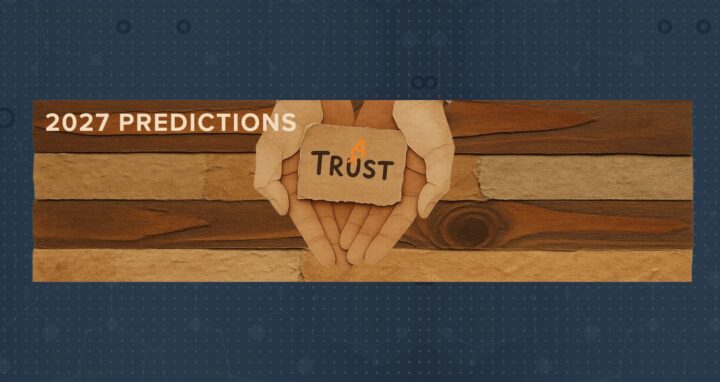
The moment a journalist, prospect, or potential partner encounters your brand online, they don’t always just stop there. Most often, they go to your website. Not because they were directed to, but because that’s where verification happens. The question they arrive with isn’t “Does this look good?” It’s “Can I trust this?”
The 2025 Edelman Trust Barometer puts significant stakes on the answer: at 64% global trust, business is now more trusted than government, media, or NGOs. More striking is what roots that trust. For employees, they trust their own employers more than they trust news media or public officials. Organizations have become de facto sources of credible information, whether they’ve prepared for that role or not.
Your company’s voice carries real weight. Your website is where audiences decide whether it deserves to. The most urgent shift marketers need to make isn’t a new channel strategy or revised content calendar. It’s treating the website as an active, living architecture of credibility, not a project you launch and revisit annually.
From Storytelling to Story Stewardship
Marketing’s dominant metaphor has long been storytelling. Brands tell stories. Campaigns carry narratives. Content is crafted and launched. But in 2026, storytelling is no longer the primary challenge, but story stewardship.
Story stewardship means actively managing what your brand narrative looks like across surfaces you don’t control: AI search summaries, algorithmic recommendation engines, curated newsletters, audio, video, and micro-community platforms. It means ensuring that when audiences move from those touchpoints to your website, they encounter a coherent, defensible version of who you are.
The website is the one surface you control entirely. That means it not just a destination for users but a narrative anchor. A company’s website is the place where every fragmented signal can be reoriented around your authoritative version of the truth.
AI Has Changed Where Trust Decisions Get Made
AI-driven discovery has fundamentally changed how brands get found and evaluated. Google’s AI Overviews, Perplexity, and ChatGPT search now answer questions directly, pulling from structured, authoritative content, before a user ever clicks through to a website. Gartner’s 2026 Strategic Predictions estimate that by 2028, 90% of B2B buying will be AI agent intermediated, pushing over $15 trillion in spend through AI agent exchanges.
Brands with authoritative, content-rich, well-structured websites are far more likely to be surfaced. Brands with thin, outdated, or opaque sites aren’t just harder to find, but they will become effectively invisible.
This creates a concrete strategic obligation that has nothing to do with content volume. It means structuring content so AI systems can parse, cite, and accurately represent it, with clear author attribution, publication dates, and factual claims that hold up under synthesis.
It means investing in thought leadership that positions the brand as a primary source, not a secondary one. It means treating SEO (or GEO) not as keyword optimization but as authority signaling, demonstrating to algorithmic engines that this is the original and most credible source on a given topic.
The marketer’s role has shifted from content broadcaster to context curator. HubSpot’s 2026 State of Marketing report frames the stakes directly: AI is now the baseline, not the differentiator. What differentiates is the brand’s point of view, and that point of view has to live somewhere. The website is where it either holds up or falls apart.
Credibility Is the New Differentiator
Misinformation is not an occasional disruption—it is the default condition. False narratives about your brand, leadership, or products can reach audiences before you have a chance to respond. When they do, audiences go to your website. If they find a site thin on evidence and poorly organized to answer basic credibility questions, misinformation fills that vacuum.
This is where organizations often discover a costly gap. Earned media and campaigns drive motivated, qualified traffic to your website. That traffic that has already completed a trust signal. If the website doesn’t meet that moment, the trust the campaign earned is lost. Bounce rates spike when landing page messaging doesn’t match the source that drove the visit. The campaign did its job. The website did not.
Integration Is Architecture, Not Coordination
Integration means the narrative in a news release, the positioning in a paid campaign, and the language on your homepage aren’t just aligned, but they are architecturally connected. Internal links amplify earned media. Landing pages match campaign context. SEO reflects the full brand narrative, not just high-volume keywords.
Organizations winning in credibility-driven markets treat the website the way they treat media relations: not as a project that concludes at launch, but as something requiring active, ongoing stewardship.
The Website as Verification Engine
Some note that much of their audience never makes it to the website at all, that AI-summarized answers and in-platform content increasingly complete the journey. That observation is exactly the point. When your brand is encountered and evaluated in spaces you don’t control, your website becomes more important, not less, because it is the one place the audience can choose to go to verify.
The brands that win are not simply the loudest across distributed channels. They are the ones whose website is coherent and credible enough to close the gap between discovery and confirmed trust. That means treating it as a living asset: updated with authority, structured for AI discoverability, integrated with every major campaign, and designed around proof and experience rather than volume.
Your website is no longer just a digital home. It is your verification engine—the place where audiences do not just learn but decide. Whether they decide in your favor depends on whether you’ve treated it like the strategic center of gravity it has become.
To get more details and insights, view the full post at In 2026, Marketers Can’t Treat Their Website Like a Project. It’s Your Verification Engine.