Why should you care about brand sentiment when you are getting enough SEO, media mentions and social visibility to drive your sales?
It is true, brands have never had more tools for producing visibility. However, the fault lines of that approach are beginning to show. Across several research findings, the conclusion has emerged that exposure alone is losing its value.
According to The GEO and AI Visibility 2026 Report from Worldcom partner Corporate Ink, 72% of marketers see AI misrepresent their brand; and 29% aren’t addressing it. Instead, they are planning more content, even when 43% don’t know which buyer prompts they want to show up for.
Shift in Measurement of Brand Sentiment
As we enter the next phase of Artificial Intelligence (AI) era, there is growing evidence about the relationship between positive sentiment and AI citation/ranking. In the past, brand sentiment was used to measure reputation. On its current path, it is now turning into the infrastructure needed for AI visibility.
Here is the shift: brand sentiment is moving from a measured communications outcome to the metric that is fueling discoverability, credibility and authority. That shift was created by AI because it synthesizes the distributed reputation brands have accumulated across earned media, social conversation, reviews, experts and other third-party sources.
The research study, Science of Desire, by Havas argues that 84% of brands occupy a middle ground of indifference. Their study of than 87,000 respondents and 2,400 brands maps a relationship between brand and performance.
For the brands with stronger desire scores, they are able to not only achieve substantially better outcomes including 2.2x greater fame, but also show a 2.4x growth multiplier. The study’s basic premise is that awareness without attraction, affinity and attachment leaves considerable growth unrealized.
From the Old Model to the Emerging Model
In the 1930’s, the fields of sentiment and measurement were starting to emerge in communications. Rensis Likert’s published “A Technique for the Measurement of Attitudes” [1] and George Gallup started nationwide radio audience measurement [2] while he was working at Young & Rubicam. Since that time, the concept of measurement and brand to evolve and morphed over time into modern brand sentiment metric. The AI era is morphing the model for brand measurement again.
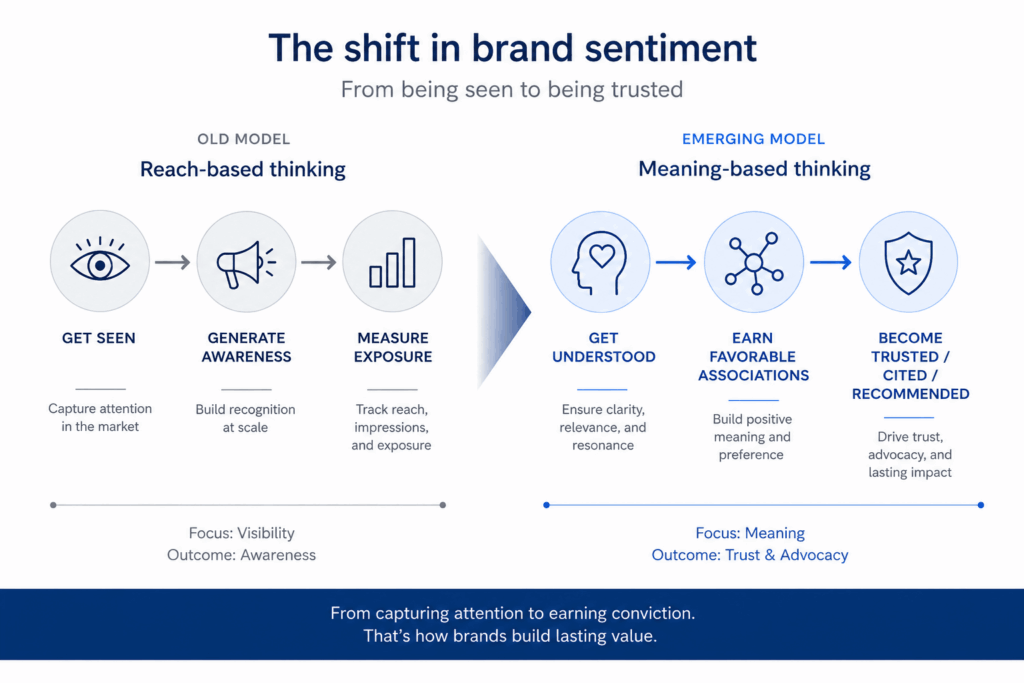
The old model of brand perception was based on visibility: get seen, generate awareness and measure the exposure. The emerging model is focused on meaning: get understood, earn favorable associations and become trusted / cited / recommended.
In the 2026 Worldcom PR Group Cannes panel, Leigh McKenzie of Semrush addressed this in one of his answers. “Build a great brand, amplify it with great PR where people actually want to choose you. Where you are speaking their language and solving a problem. But, think holistically, not piece by piece.“
This approach speaks to the new challenge where brand and AI have met head on. According to the Havas study, brands that are surrounded by stronger third-party mentions and cultural conversation are roughly four times more likely to appear in AI citations.
The New Challenge of Brand Sentiment
With a strong impact of AI and visibility, brands and agencies need to shift to examining the signals splintered in the digital ecosphere rather than providing a conventional positive/negative sentiment score.
Why?
Because machines increasingly encounter and synthesize brand sentiment before people even encounter a brand. The tools they are using to make decisions are either direct AI agents or highly impacted by AI / LLM algorithms.
Through this evolution, “sentiment” is actually being expressed through several overlapping constructs that include:
- Attraction, Affinity and Attachment
- Trust + relevance
- Impression, quality, value, satisfaction, reputation and recommendation
- Narrative accuracy, authority, trust signals, corroboration and favorable framing
That means you have to look at all the ways – not just one way – that your brand needs to stand up to measurement.
Public opinion and data company YouGov has been developing brand ranking reviews. They combine conventional longitudinal BrandIndex metrics with AI-assisted analysis of actual consumer interviews. For the top brands, they look a conversations for a brand and break them into themes and score each for sentiment and engagement rather than treating the entire brand as simply “positive” or “negative.”
Now, the movement is to answer why people feel as they do toward a brand, not merely whether the feeling is positive. That means agencies should treat sentiment as a multidimensional reputation dataset. Brand is composed of elements such as topic, audience, source, narrative, intensity and behavior—not a single percentage.
Quality Trumps Quantity.
Lending his insights on the topic of AI measurement, John Deveney said brands need to “bring rigor, consistency, and transparency to how organizations think about AI-era discoverability and influence.” The top priority on this list was that authority matters more than attention.
AI systems do not evaluate credibility the same way humans do. Systems heavily prioritize:
- Trusted third-party validation
- High-authority earned media
- Expert citations
- Consistency across sources
- Structured and reliable information
- Recognized institutional expertise
Authority matters more than attention. This means strategic, well-executed reputation architecture will be more important than visibility volume.
It was a sentiment that was echoed by Elisa Lesieur, PR Director at Yucatan. She joined other Worldcom PR Group Partners at CANNES to participate in a panel “Breaking Through the Noise: Authenticity, Trust & Platform Credibility in the AI Era.” During the discussion, she brought up this issues for brands.
“It is less about visibility, and more about credibility, and we don’t bring credibility with volume, we bring credibility with alignment.”
Building AI Brand Authority
Understanding the process for AI authority produces a simple conceptual chain that runs from public experience through conversation to human perception.
Now the path has a longer road to travel than just brand to consumer. The path starts with a public experience that will generate a conversation. From those conversations, earned media takes the stage with third party media / consumer sources. That is where AI steps into the fold with machine synthesis that can generate an AI answer and either impact human perception or keep a brand invisible in the decision process.
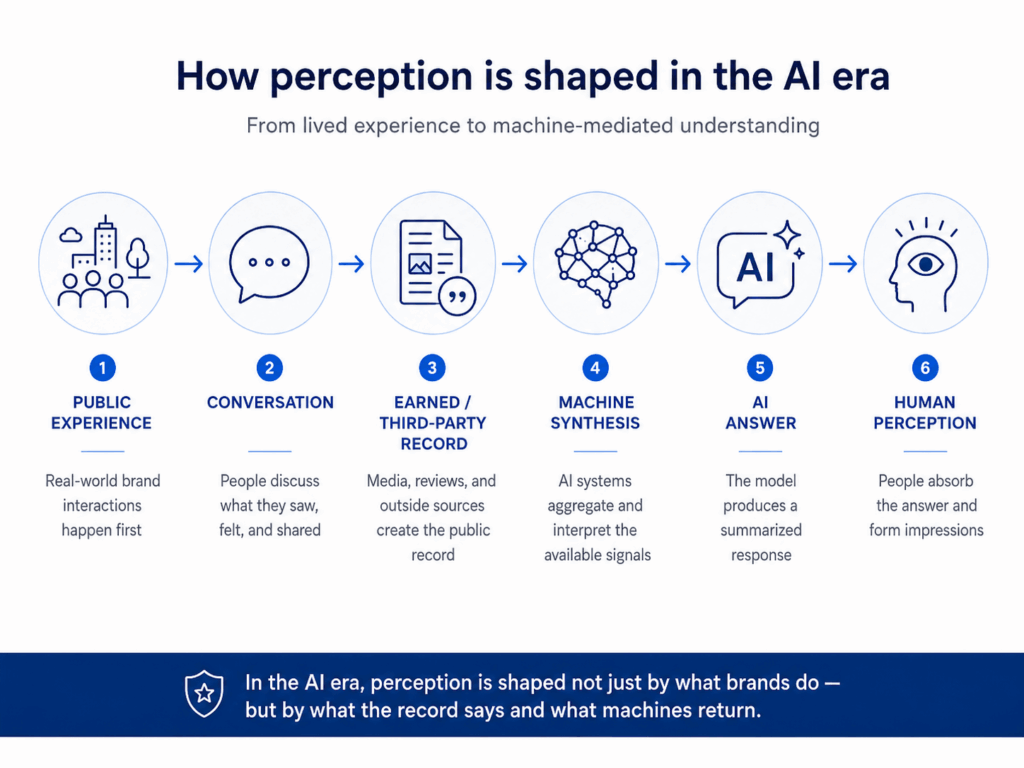
As you look at the studies being done, different firms use different terminology. However, they are converging on the same underlying proposition: strong brands accumulate favorable interactions that affect choice, advocacy and reputational resilience.
We tackled this issue in its recent study 2026 Where Trust Lives: Sources for Credibility in Local Markets. The current reality is that AI systems evaluate language patterns already present in journalism, expert commentary, reviews, social discussion and other external sources rather than simply accepting brand claims.
For consumers, they are making determinations about brand from the sources they already trust. For AI, those tools are dependent on authority generated for sources they consider trustworthy and can be indexed in the digital universe. The communications consequence is important: PR is no longer merely trying to influence what someone reads. It is increasingly influencing the corpus from which machines construct an answer.
No matter what study you read, the reality is that understanding a brand means creating an outside-in audit of what those sources actually say. It also means that more than ever before, brands are losing control of their reputations to consumer conversation and AI responses.
Is it AI v. Humans . . . or something else?
A McKinsey State of Marketing Europe 2026 indicates that European CMOs plan to invest in AI. However, 62% of respondents still regard human creative teams as irreplaceable for differentiated, high-quality concepts.
What we are seeing is that AI is strongest as an intelligence and amplification layer precisely when brands need human distinctiveness most. So, the contradiction is not completely a AI versus human conversation.
There is a place for AI in the marketing field. The play is to not use AI to produce more, but to produce more, and better, consumer insights. Tools like SmartFocus.ai are able to harness AI technology to build virtual focus groups to generate ideas, test concepts and provide initial feedback on brand sentiment. The brands that use AI to understand sentiment faster can add experience and human knowledge to create ideas. It doesn’t mean making ideas with AI and translating them.
As Bill Imada of IW Group said during the Worldcom Cannes panel, “Translation does not mean authenticity, nor does it mean representation. You’ve got to connect with the consumer in a language they appreciate, the stories that resonate with them and align with their values.”
It is human understanding that unlocks the opportunity, and human creativity that generates desire. AI can be used to generate hype and insights, but sustainable performance must show more to consumers. It needs to have equity, real innovation and genuine expertise.
Reputation has Become Machine-readable
Public Relations once treated brand sentiment as a report on what had already happened. With the rise of social media, it became an early-warning indicator. AI may now be turning it into an input to what happens next.
Brand is not just about the moment. A brand’s accumulated public record coverage, commentary, reviews, community conversation, executive expertise, customer experience and third-party validation are increasingly being synthesized, and AI is making decisions about your brand.
Sentiment is on the rise as a strong authority signal. We do not yet know precisely how much weight AI tools will give it, or which forms of sentiment matter most. That measurement problem is where the next generation of reputation management begins.
Now, the job of Public Relations is to expand from just earning attention to using human ingenuity to engineer a credible information environment.
Further Insights from Our Partners
There are many lessons that need to be absorbed to understand what ‘brand’ means. There are different layers that should be considered when developing your approach. We gathered insights from our network of PR partners around the world to let you get more details about the content you are interested in reading.
- 2026 Where Trust Lives: Sources for Credibility in Local Markets
- AI is becoming your brand’s new shop window | August 2026
- AI is Rewriting Brand Discovery & Reputation: Here’s How Smart Marketers are Adapting
- AI Is Rewriting the Rules of Visibility—and Reputation Is Winning
- Brand Strategy 2026: Technology, Experience and Commitment Focused on Client Relationships
- Brand Visibility for Manufacturers: Why PR Matters
- Business Messaging Strategy: Is Yours Keeping Up With Change?
- From FIFA’s Stadium Names to Brand Visibility in the AI Era
- Generative Engine Optimization: Reputation, Visibility, and Influence
- How AI Search Determines if Your Content Surfaces
- How to Make a Branded Podcast People Want to Listen to
- How Storytelling Transforms PR: From Products to Purpose
- How True Helps Brands Stay Visible in the AI Landscape
- Is AI recommending your brand?
- Is AI Ruining Your Employer Brand?
- Is Authentic Voice Becoming A Competitor Advantage?
- Reach or Relevance? Why Reach Is Overrated in Today’s Communications
- Social Media Listening: From Conversation To Insight
- The GEO and AI Visibility 2026 Report
- Why Audiences and AI Engines Are Turning on AI Slop
- Why Authenticity Matters More Than Ever in the Age of AI
- Why Most Brand Messaging Fails Before the Launch
- Why People Build Better Brands: The Faces Behind the Feed
- Why Pharma’s Localization Gap Is Costing It Credibility
You can also explore our extensive library with insight posts on AI and Brand.