
This insights post is a summary of the blog post published by Yucatan. View the full article at: Information: How to Manage Audience Information Fatigue and Brand Distrust?
In 2026, news consumption is defined by a profound reconfiguration of the media landscape. It is through those changes that public trust has experienced a growing erosion. According to the Reuters Institute’s Digital News Report 2026, this shift in trust is being caused by a massive migration toward social platforms as new sources. That is coupled with a surge in active traditional news avoidance.
For communications professionals, understanding these dynamics is essential to restoring brand credibility, optimizing audience engagement, and knowing how to manage information fatigue.
Key Report Takeaways
In the report, there were several elements that stood out as the most important in the research including:
- News consumption in 2026 is marked by rising distrust and active avoidance of the news cycle.
- Social platforms have overtaken traditional media as the primary gateway to information.
- Information overload is pushing audiences to filter content in order to protect their attention.
- Transparency of intent and editorial quality are becoming strategic assets for rebuilding trust.
- Brands must prioritize content relevance and hierarchy over sheer volume.
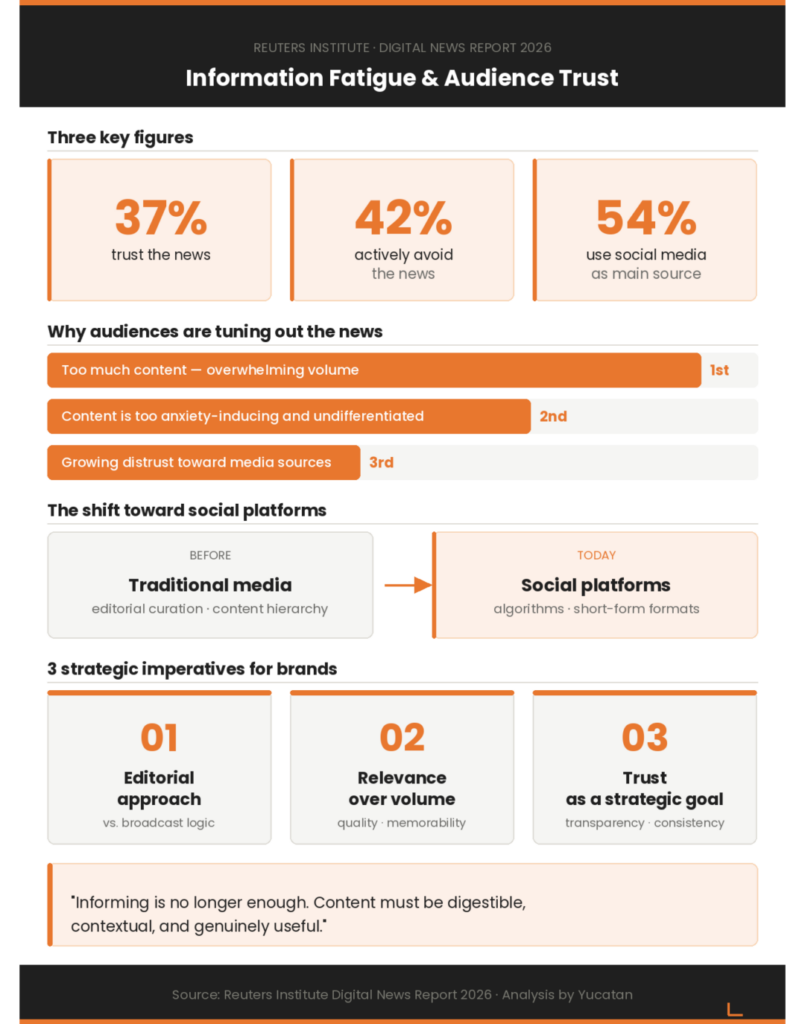
A few figures capture the scale of the phenomenon: only 37% of respondents say they trust the news, and 42% actively avoid it. Meanwhile, social networks and video platforms have become the leading point of access to information (54%), ahead of traditional media.
This is more than a crisis — it is a paradigm shift.
What Is Driving and Impacted by the Shift
- How Audience Information Fatigue Is Reshaping Expectations: News avoidance doesn’t reflect disengagement — it reflects saturation. Too much content, too anxiety-inducing, too undifferentiated.
- The Impact of Social Platforms on Information Distribution: The shift toward social networks marks a structural transformation: news is now consumed in algorithmic environments designed to capture attention, not to organize or prioritize information.
- Why Trust Has Become a Strategic Asset in Editorial Communications: In a climate of widespread distrust toward media, brand credibility is no longer a given — it must be built through transparency.
- Why Editorial Quality Must Take Priority Over Volume: Faced with information overload, brands’ mass content production is showing its limits — and may actually reinforce audience avoidance.
To get more insights and details from Yucatan, read the full article at: Information: How to Manage Audience Information Fatigue and Brand Distrust?